Here you'll find an array of activities for elementary children that can be used in Children's Ministry, after-school programs, in the classroom and by homeschoolers.
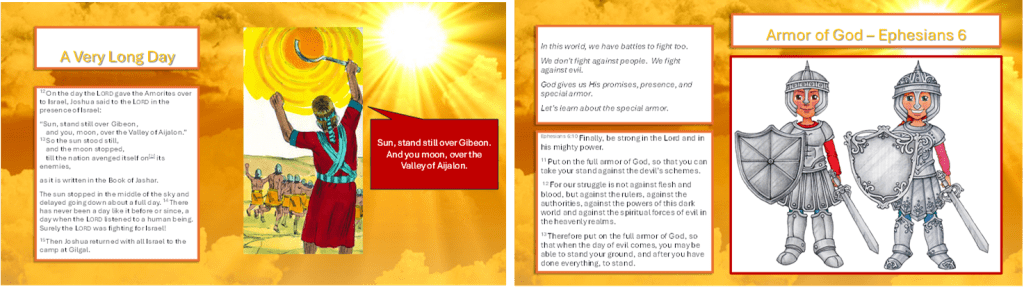
Five kings are upset that Gibeon, a fellow royal city, has made a peace treaty with Joshua. They rise up against Gibeon. Gibeon sends an urgent message to Joshua asking for help. He quickly responds with the full army of Israel. They march all night, attack, and fight throughout the day. God fights for them by sending large hailstones. Near the end of the day, Joshua sees that they need more time to seal the victory. He commands the sun and moon to stand still. God performs the miracle. Amazing!
Just like Joshua fought the evil kingdoms and was victorious, Jesus is fighting the Devil’s evil kingdom and is victorious! With Jesus, we too will be victorious! Put on the full armor of God!
God kept His promise to Abraham, Isaac, Jacob, and the Israelites. God gave them the Promised Land. We, too, have a Promised Land — heaven and the earth made new. We only need to believe in Jesus. He will help us to be strong, courageous, and faithful because He loves us so very, very much!
Thanks to God’s marvelous help, the Israelites had conquered several kingdoms. The neighboring kings were troubled, or should we say, scared. King Balak had a plan. He knew whoever Balaam cursed would truly be cursed (and whoever he blessed, would be blessed). So he called Balaam. Would Balaam curse the Israelites so Balak could conquer them? No, Balaam listened to God and blessed them — after being persuaded by an Angel and his talking donkey.
In this PowerPoint lesson, the kids have an opportunity to watch a short video of the story and then act it out. There also is a video about donkeys. Did you know donkey’s stubbornness is often due to their smart intellect and strong desire to stay safe? King Balak wanted to be safe, too. However, in his quest for safety, he actually condemned his kingdom. Before this story, God tells the Israelites to leave Moab alone because these are the descendants of Lot. Afterwards however, because of the trap they laid for the Israelites, their kingdom was condemned and they were told to treat them as their enemies.
At the end the kids have the opportunity to make a card and write a blessing inside for someone else. You can use this pdf for the inside messages. Print on white cardstock. Fold the paper in half and have the kids decorate the outside with flowers, hearts, or an umbrella and confetti. May God shower you with blessings.
We have gone through many of the books of Moses: Exodus, Numbers, Leviticus, and Deuteronomy. Our study of the life of Moses is drawing to an end. Moses’ life on earth is drawing to an end. He wants the people to be successful. He wants them to be faithful to God and to remember God’s covenant to them. So, in the book of Deuteronomy, Moses reminds the people of all these things. God has plans to prosper us, to give us hope and a future. This is the intent of His Covenant and Commands.
This passage is especially meaningful to me, because this is the passage that my dad read to all of us as part of his final words before he passed away. God really wants us to be with Him. He has done and is doing all He can to make it possible.
In this lesson, we’ll review the 10 commandments and learn about Moses’ death. Though Moses died and was buried by God Himself, we know that he was resurrected because he appeared to Jesus when He was transfigured (Matthew 17:1-8).
In this lesson the kids have an opportunity to make Moses, get prizes for filling in the blanks of the commandments, and show that they remember the stories of Moses by doing charades.
The Israelites again began complaining. Are we really any different? Do we not also complain about our leaders? Of course they aren’t perfect, neither are we. Yet God’s Word teaches us to respect authority because it is God Himself who has allowed them to be in a position of authority. How did God solve this problem of complaining about authority? Numbers 17 tells the story of the leaders putting their staffs in the tent of meeting. These staffs represented their authority. God said they would know who was chosen to be High Priest because his staff would leaf out. In the morning, it was Aaron’s rod that had leaves. Just for good measure, God saw to it that it also had blossoms and almonds!
Interesting side note, as we see in Ezekiel’s vision ( ), the Hebrew word for “almond” is similar to “watching.” The almond tree was the first to bloom and was a signal of spring. Just like they watched for the almond blossoms, God watches us for signs of faith and growth.
In this lesson, the kids can decorate sticks with tissue paper blossoms and paper leaves (or you can use silk flowers) and almonds. For a special snack, you can have them make almond sticks out of almond flour or dip pretzel rods in melted chocolate and put on almonds. I added frosting flowers and leaves.
The Tabernacle’s first compartment from the East was the Holy Place. This is where the priests served every day. The furniture here teach us about God’s work within His people. It shows us how to connect with God each and every day and become His holy people (1 Peter 1:14-16), set apart to do His good works which He has created us to do (Ephesians 2:10).
To enter the Holy Place, first enter into the Tabernacle courtyard, through the one gate, which represents Jesus, the One Way to salvation and to the Father (John 14:6). Stop at the altar of sacrifice where we bring our offerings in humility, confession, thanksgiving and praise. Here we reflect on God’s greatest gift, the gift of His Son, Jesus, our Savior, the Lamb of God, who takes away the sins of the world (John 3:16, John 1:29). Continue on to the reflective basin of water. How can we reflect God’s love and goodness? Jesus cleanses us from all unrighteousness (1 John 1:9). Now we can proceed through the curtain of the Holy Place to continue this journey of holiness. On our right we see the seven branched candlestick. On our left is the table with twelve loaves of bread. Straight ahead is the altar of incense.
This is the area in which the lesson focuses on. The PowerPoint lesson and children’s activities can be found below. The pictures shown here are part of the PowerPoint lesson.
The light of the candlesticks glimmers on the golden walls and golden embroidery of the cherubim. It was not made out of acacia wood and covered with gold like most of the furniture here. It was beaten and formed from a talent of pure gold. It was all one piece. Who is pure, holy, and beaten? Jesus! It had seven branches, 3 from each side and one central that were decorated with almonds and almond blossoms. The top blossoms were the oil basins for the lamps. Jesus said, “I am light of the world” (John 8:12, 9:5). He also said, “you are the light of the world” and “Let your light shine that your good works will glorify God.” (Matthew 5:14-16). Jesus came and did many good works which glorified God. He taught, healed and graciously helped so many. We are encouraged to do the same by His name and power to glorify God. He sent His Holy Spirit, the oil, that works with Christ to fill us, teach us, write His law within us, and change us to be like Jesus (John 14:25-26, John 16:8-13). Each day the priest were to keep the lamps trim, filled, and burning. Jesus, please trim us and fill us so that we can burn brightly. Just like the branches extend from the central stand, I want to follow Jesus’ desire that we abide with Him (John 15:1-17).
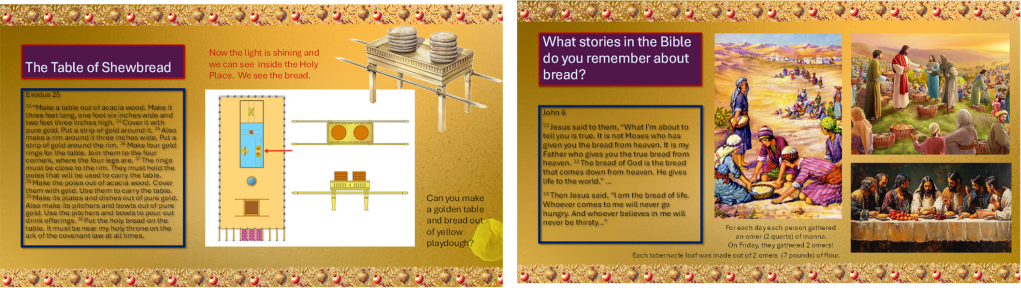
The light shines across the room and we see the golden table with twelve loaves of bread. The table was made out of acacia wood and covered with gold. The bread was called the shew bread or bread of the Presence. New loaves were placed on the table every Sabbath along with incense and the old loaves were eaten by the priest in the presence of the LORD in the Holy Place. (Exodus 25:23-30; Leviticus 24:5-9) There were twelve loaves which brings to mind the twelve tribes of Israel and the twelve apostles. Israel was chosen to be a nation of priests to share God’s plan of salvation (Exodus 19:5-6). The apostles were chosen of witnesses of that plan of salvation fulfilled in the life, death, and resurrection of Jesus. They along with us were commissioned to go tell the world that our Savior has come, we are redeemed and saved (Revelations 1:4-6; 5:9-10; Matthew 28,18-20)! Furthermore, the bread represents God’s Word. God’s Word became flesh and dwelt among us, that’s Jesus. Jesus said, “I am the bread (from heaven) of (that gives eternal) life.” (Deuteronomy 8:3; Luke 3:3, 9-10, 28; John 6:31-40) Jesus, please give us our daily bread, teach us from your Word, the Bible and set your Word within our hearts that we may not sin against you. We want to feed on your Word in Your presence; to hear and read the Bible daily and at church.
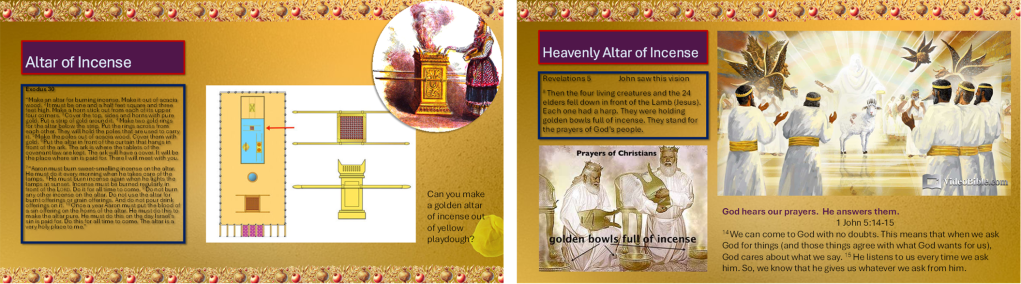
We not only smell the loaves, we also smell incense burning (Exodus 30:8-10). The altar of incense represents prayers ascending to God (Revelation 4:8; 8:3-4). Jesus daily prayed (Mark 1:35, Luke 5:16). He prayed for the disciples and you and me (John 17). We are encouraged to pray, too, that we may not fall into temptation and that we may know His will and have the strength and courage to do it (Matthew 26:41). Our Heavenly Father gladly answers all our prayers according to His good and perfect will. All good things come from the Father. Jesus, thank you that we can come boldly to your throne and present our requests before you (Hebrews 10:19-22). Thank you that you hear and answer us (Jeremiah 29:12, Matthew 7:7-11). Thank you for your love and mercy. Help us to be as a sweet smelling incense to those around us (2 Corinthians 2:14-17).
The Holy Place — The Priests Daily Work
This is the more simple version for younger children.
In this PowerPoint the kids get to make the furniture we find in the Holy Place with play-dough. They learn how gold is beaten to form an object and how olive oil is made. We talk about how we need oil (or batteries) in our lamp so that it can stay lit and sing with little tea lights. They get to eat some naan bread with olive oil and talk about Bible stories that mention bread. At the end, the final prayer is an interactive prayer, praying through the Tabernacle from the gate to the altar of incense.
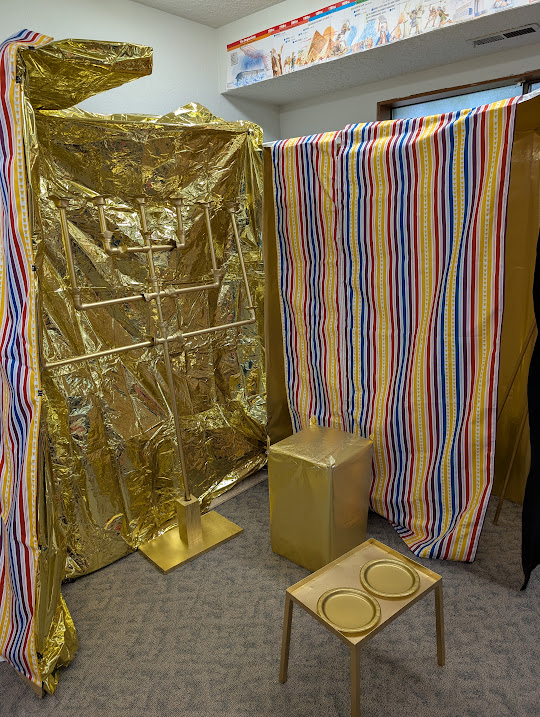
I’ve been working on making classroom Tabernacle models out of cardboard for the last few years as the items came up in Bible lessons. I made a simple altar of incense when we talked about Zechariah and John the Baptist’s birth. I made the altar of the covenant many years ago when first talking about Moses. Here are some pictures of my work. Part of the Tabernacle structure is a refrigerator box covered with gold paper. To extend it, I used gold foil tablecloths. I had the material printed for the curtain.
Altar of Incense
The altar of incense is made from a cardboard box covered in gold paper. The horns are gold paper triangles folded and taped onto the box. What is missing is the golden bowl that I put on it. I have a metal bowl spray painted gold that I can put real incense in.
Table of Bread of Presence
This one was the easiest for me because we happened to have a perfect metal table that I just had to spray paint gold.
I found gold plates at the Dollar Tree and Walmart.
Lamp stand
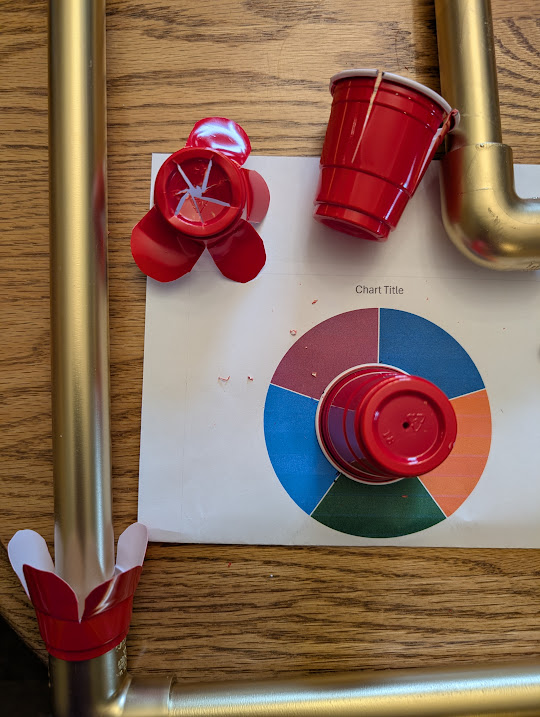
This one was by far the most difficult to make. Maybe I should have just purchased one, but I had quarter inch PVC pipe and an idea. Though this was plan B. Plan A was to get quarter inch metal pipe and have it bent to make each of the six candle branches and attach them using quarter inch fittings to the main metal pipe which would have been cut like the one in Plan B. In both plans, the pipe is painted gold and almond blossoms attached by pushing them onto the pipe. Doesn’t this sound complicated?
The center pipe is cut into the following pieces: 6″ top, 6″ to 2nd branch, 6″ to 3rd branch, 2’5″ for stand. The inner top left and right (first) branches are each cut 6 inches for outward piece and 6 inches for upper piece. They are attached with elbows and x piece in the center as the others will be also. The left and right branches of the 2nd branch are cut 12″ for each of the outward pieces and 12″ for the upper pieces. The left and right branches of the 3rd and final branch are cut 17″ for each the outward pieces and also 17″ for the upper pieces.
I cut the almond blossoms out of small plastic dixie cups . The 5 piece pie graph helped me know where to cut down to make the five petals of the almond blossom. Then I rounded each petal top. Finally, before spray painting them, I covered the inside and outside with air-dry modeling clay to help it look more like a flower. These slid onto the pipes before attaching the pipes to the connectors. The top blossoms were just big enough for battery operated tealights.
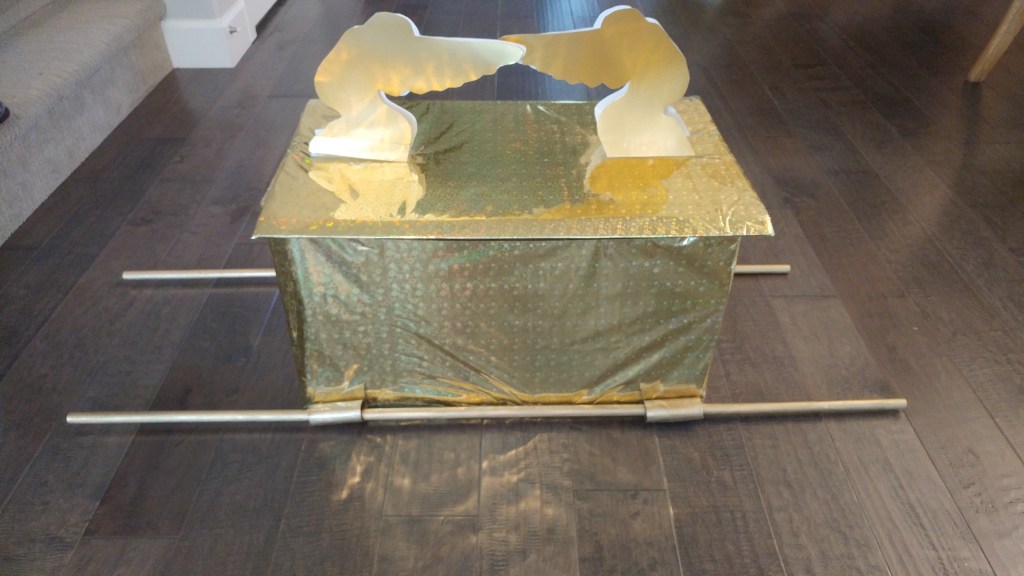
Ark of the Covenant
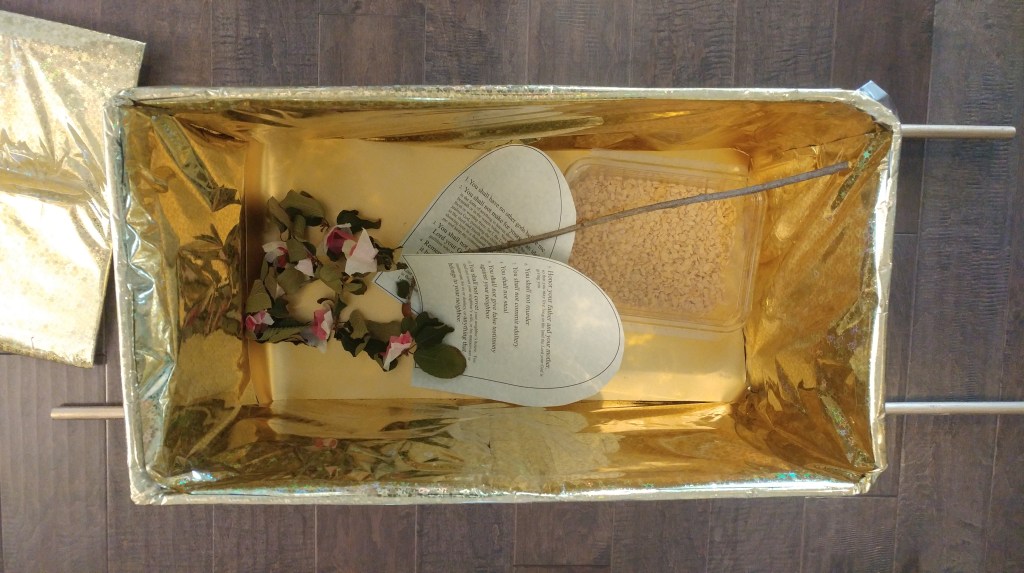
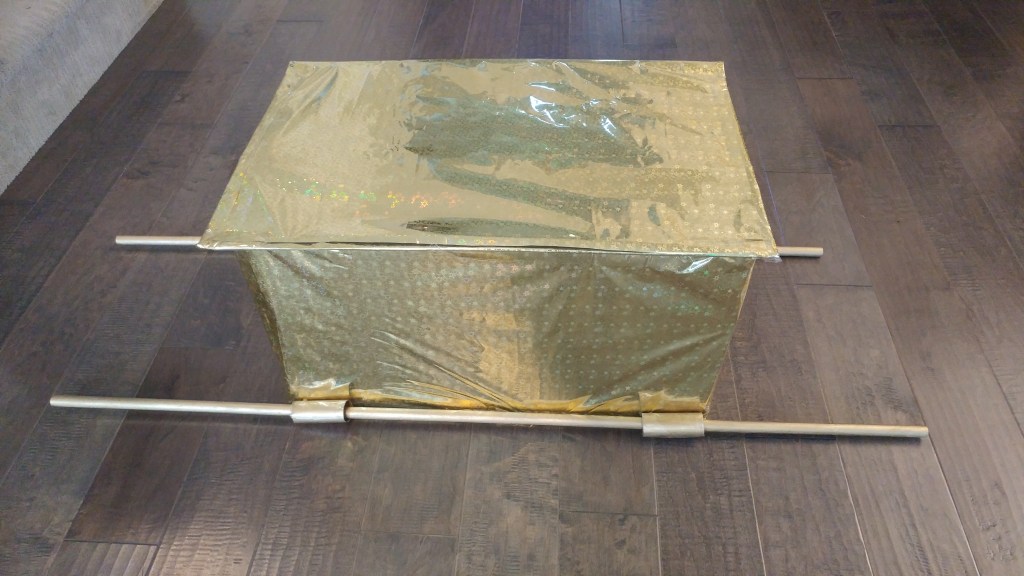
I made the Ark of the covenant from a card board box. I took of the the top flaps and covered it in gold wrapping paper. Christmas is a perfect time to find gold wrapping paper. Then I cut another piece of cardboard to fit over the top that was just a little bit bigger than the top so the box support it. I covered it with gold paper also. Then I enlarged images of the angels and cut out 4 from gold poster board with 2 facing the opposite way. They are attached with packaging tape. The nice thing is that I just flip this top upside down and it fits over the box with the angels on the inside to keep them nice. At the base of the box, I taped on toilet paper rolls painted gold to put golden dowels in so that we could carry it.
In this presentation we learn about the final aspect of the Tabernacle which is the Most Holy Place and the Ark of the Covenant which was placed there. Then we talk about Moses setting up the Tabernacle. God responds by filling the Tabernacle with His presence! The whole message points to how God wants to be with us. Our text is Jude 24. God has made a way for us to come before His presence with great joy! The craft is priest or coloring picture of the High Priest. I had hoped we would have time for both, but we only had time for one. “Give praise to the God who is able to keep you from falling into sin. He will bring you into his heavenly glory without any fault. He will bring you there with great joy.”
God told Moses how to set up the Tabernacle. (Exodus 40) It tells the story of Redemption. Ironically this story of Redemption happens on the anniversary of Israel’s freedom from Egypt. God works like that. It is His purpose. God told Moses to erect the Tabernacle. I’m not sure how exactly they erected the tabernacle, but it included setting up the 48 golden wall panels set in bases of silver and laying over them the roof coverings. (Exodus 36).
Let’s consider the meaning behind those coverings. The first and inmost covering was the woven linen covering that included colors that tell us about God’s ministry: white because God is Holy and pure, purple because God is King, blue because He is faithful to His promises and just in His law, red because He loves us so much that He gave His only Son [Jesus gave His life for us] that whoever believes in Him might not perish but have everlasting life (John 3:16). Golden cherubim were woven in the cloth. The cherubim continually worship God and remind all present that God is Holy, Holy, Holy. This first covering shows God’s grandeur, holiness, and perfect plan. The second covering is goat’s hair. I learned that black goats hair was commonly used for tents because it naturally provided protection from the sun by absorbing the UV rays, protection from heat because when it was dry it let the air flow through the loose fibers, and protection from rain because when wet the fibers expand and become water proof. It reminds me of God’s mercy and protection. Black reminds me of our sin. While we were yet sinners, Christ died for us. (Romans 5:8) Over this, the third covering speaks of His death. This cover was ram skin died red. We hear of this in other redemption stories foretelling the story of Jesus. Abraham was asked to offer Isaac as a sacrifice, but, as Abraham himself prophesied, God would and did provide a ram. (Genesis 22:1-14). Finally, over this was a durable leather. This message is for all people everywhere for all time.
I find the order that God told Moses to set the items within the sanctuary most fascinating. I believe it tells of God coming to tabernacle with us; It tells Jesus’ life story. First Moses was told to bring in the Ark of the Covenant and set it within the Most Holy Place (Exodus 40). This represents God’s throne room in heaven. Or might we say His judgement seat, His Supreme Court. The Ark of the Covenant’s name talks about God’s first Covenant; His promise to be Israel’s God; and His law and testament (Exodus 20). Now a New Covenant is established. Jesus has fulfilled the first Covenant and promised that He will write His law on our hearts. (Jeremiah 31:33, Romans 2:14-15) His law is within us like it was within the Ark of the Covenant. Above the gold covered ark box is the pure gold cover with cherubim facing each other and looking down upon what is called the Mercy Seat (Exodus 37:1-9). Here is the other aspect of God’s judgement seat, it is His Mercy. It is this mercy that is demonstrated in the Tabernacle’s and Jesus’ Redemption story. Then Moses hung the curtain that separated the Most Holy Place from the Holy place which veiled God’s glory. (Spoiler Alert: The debt was paid, we are redeemed, the veil was torn as Jesus said, “It is Finished”, now we can come boldly before the throne.)
The second piece of furniture to be brought in was the Table that held the Bread of Presence (Exodus 25:23-30). God came from heaven. Jesus was the bread of life, the true bread from heaven, born in Bethlehem, the city of bread, born to give us life. (John 6:30-40) He will be called, Immanuel, God with us (Matthew 1:23).
The third piece of furniture to be placed was the lamp stand, which also represents Jesus. He also is the light of the world (John 8:12). Because He came, we do not need to walk in darkness. Jesus came to show us God’s love through His good works. He encourages us to also let our light shine so that our good works will glorify the LORD in heaven (Matthew 5:16).
Then the altar of incense was placed in front of the curtain that separated the Holy Place from the Most Holy Place. The smoke and aroma of this incense on this table would continually rise as our prayers rise to heaven. Jesus continually prayed (Luke 5:16). He prayed for his disciples and for us (John 17). What other insights can be drawn from this altar?
After Moses hung up the curtain in front of the Holy Place, he set up the Altar of Sacrifice. Here we see foreshadowed Jesus’ death. Jesus, the lamb of God, came to take away the sin of the world once and for all. It was a perfect sacrifice. (John 1:29, Hebrews 10:5-14)
Finally, the basin of water was set up. Jesus said, “‘Let anyone who is thirsty come to me and drink. Whoever believes in me, as Scripture has said, rivers of living water will flow from within them.” By this he meant the Spirit, whom those who believed in him were later to receive. Up to that time the Spirit had not been given, since Jesus had not yet been glorified.'” (John 7:37-39)
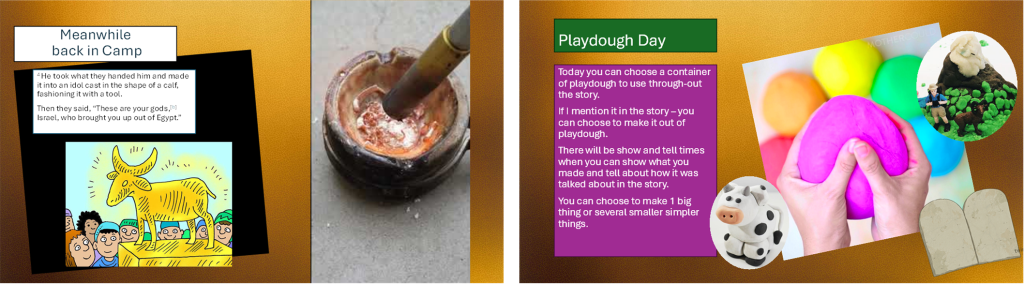
The Israelites had just seen the power of the LORD in the plagues on Egypt, the parting of the Red Sea, their captors demise, God bringing water from a rock, God sending manna each day, and His awesome giving of the 10 Commandments and covenant. They had even committed to keeping the covenant. But they didn’t. Moses was gone for 40 days on the mount. Seventy of the elders were also worshipping on the mount. But the people grew tired or complacent or anxious or…. What did go through their minds?
They asked Aaron to make them a god to lead them. The glory of the God that was leading them was still shining on the mount. Did they really want a lesser god? Aaron told them to bring their gold. They did. He fashioned a calf. The people declared that this was their god who would lead them. Aaron declared a festival to God. Wait a minute. To God?
There were many consequences to this grave sin of the graven image. Many died. Yet others deepened their commitment to the LORD.
We are starting a very special series on the Tabernacle that the Israelites built near Mt Horeb (Sinai) according to the directions and pattern given to Moses by God. It is rich in parallels that teach us about God’s best and most important gift, our salvation.
I can’t say it any better than Brennan, so I’ll share His post on the significance of the outer court. Check out his blog at: Brennan’s Pen: The Courtyard https://share.google/irJaJ4lMEJNMrTvTv
After the Golden Calf experience, many repented from their sin and truly chose to worship God. God renewed His covenant and invited the people to build a special Tabernacle. This lesson from Exodus 35 shows how much the people gave. They gave generously and cheerfully. They gave so much that Moses had to tell them to stop giving!
Exodus 38:1-9 tells about the Tabernacle Courtyard design. The courtyard was where the people came to offer their gifts. They brought sacrifices to confess their sins and also thank offerings. Here they came to pray, praise the Lord and worship. It is here that we learn about God’s greatest and most important gift, the gift of salvation.
This PowerPoint presentation (and the next 2 lessons) encourages you and the children to make a model of the sanctuary. The model can be one with felts, a paper model, or a classroom size model. The directions and ideas are given in the presentation.
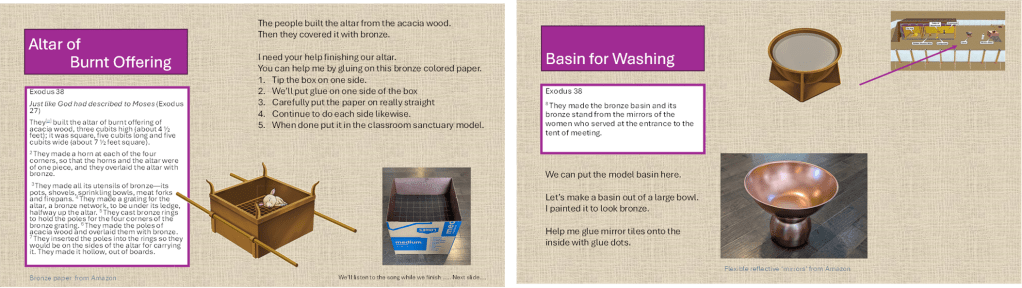
I did the basic work of making an altar, basin, and the curtains. The kids got to put on the bronze paper to finish the altar, add some more mirrors to the basin, and put up the curtains on the entry posts.
To make the altar I took one of Lowe’s blue boxes. I measured 10 inches from the top and cut around the sides of the box at that line. Then I flipped that top over so that it looks like the inner grate spoken of in scripture. I taped the sides all around. The box can easily be flattened for storage by turning it over, untaping the bottom, and then untaping the ‘top’ which is now the middle grate from its underside.
I made the basin by spray painting a very large metal bowl and metal vase with bronze spray paint. The picture doesn’t show the mirrors on it yet.













 Activity Array