
Exodus 25 and 37

The Tabernacle’s first compartment from the East was the Holy Place. This is where the priests served every day. The furniture here teach us about God’s work within His people. It shows us how to connect with God each and every day and become His holy people (1 Peter 1:14-16), set apart to do His good works which He has created us to do (Ephesians 2:10).
To enter the Holy Place, first enter into the Tabernacle courtyard, through the one gate, which represents Jesus, the One Way to salvation and to the Father (John 14:6). Stop at the altar of sacrifice where we bring our offerings in humility, confession, thanksgiving and praise. Here we reflect on God’s greatest gift, the gift of His Son, Jesus, our Savior, the Lamb of God, who takes away the sins of the world (John 3:16, John 1:29). Continue on to the reflective basin of water. How can we reflect God’s love and goodness? Jesus cleanses us from all unrighteousness (1 John 1:9). Now we can proceed through the curtain of the Holy Place to continue this journey of holiness. On our right we see the seven branched candlestick. On our left is the table with twelve loaves of bread. Straight ahead is the altar of incense.
This is the area in which the lesson focuses on. The PowerPoint lesson and children’s activities can be found below. The pictures shown here are part of the PowerPoint lesson.

The light of the candlesticks glimmers on the golden walls and golden embroidery of the cherubim. It was not made out of acacia wood and covered with gold like most of the furniture here. It was beaten and formed from a talent of pure gold. It was all one piece. Who is pure, holy, and beaten? Jesus! It had seven branches, 3 from each side and one central that were decorated with almonds and almond blossoms. The top blossoms were the oil basins for the lamps. Jesus said, “I am light of the world” (John 8:12, 9:5). He also said, “you are the light of the world” and “Let your light shine that your good works will glorify God.” (Matthew 5:14-16). Jesus came and did many good works which glorified God. He taught, healed and graciously helped so many. We are encouraged to do the same by His name and power to glorify God. He sent His Holy Spirit, the oil, that works with Christ to fill us, teach us, write His law within us, and change us to be like Jesus (John 14:25-26, John 16:8-13). Each day the priest were to keep the lamps trim, filled, and burning. Jesus, please trim us and fill us so that we can burn brightly. Just like the branches extend from the central stand, I want to follow Jesus’ desire that we abide with Him (John 15:1-17).
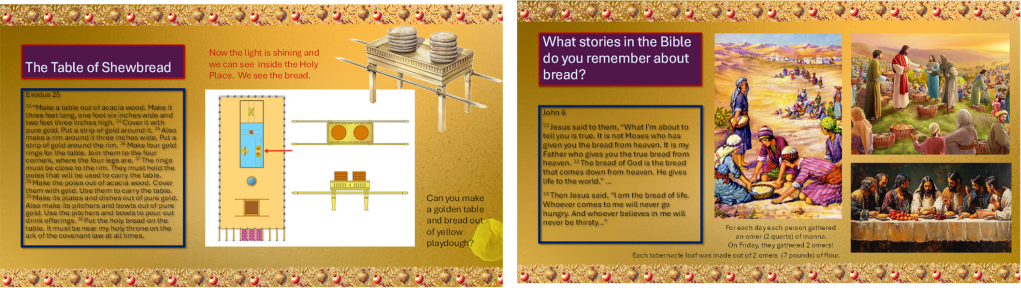
The light shines across the room and we see the golden table with twelve loaves of bread. The table was made out of acacia wood and covered with gold. The bread was called the shew bread or bread of the Presence. New loaves were placed on the table every Sabbath along with incense and the old loaves were eaten by the priest in the presence of the LORD in the Holy Place. (Exodus 25:23-30; Leviticus 24:5-9) There were twelve loaves which brings to mind the twelve tribes of Israel and the twelve apostles. Israel was chosen to be a nation of priests to share God’s plan of salvation (Exodus 19:5-6). The apostles were chosen of witnesses of that plan of salvation fulfilled in the life, death, and resurrection of Jesus. They along with us were commissioned to go tell the world that our Savior has come, we are redeemed and saved (Revelations 1:4-6; 5:9-10; Matthew 28,18-20)! Furthermore, the bread represents God’s Word. God’s Word became flesh and dwelt among us, that’s Jesus. Jesus said, “I am the bread (from heaven) of (that gives eternal) life.” (Deuteronomy 8:3; Luke 3:3, 9-10, 28; John 6:31-40) Jesus, please give us our daily bread, teach us from your Word, the Bible and set your Word within our hearts that we may not sin against you. We want to feed on your Word in Your presence; to hear and read the Bible daily and at church.
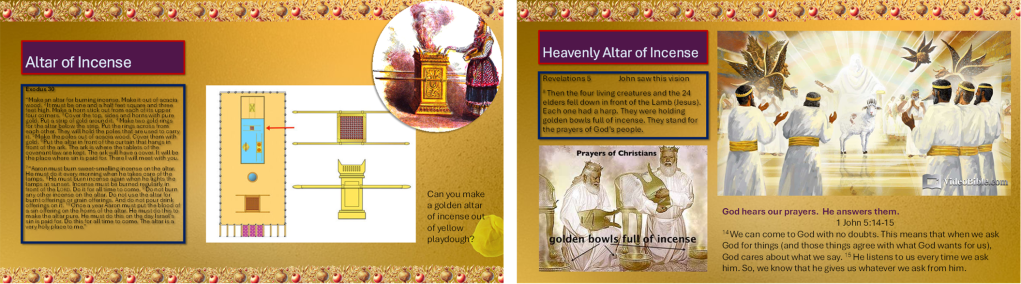
We not only smell the loaves, we also smell incense burning (Exodus 30:8-10). The altar of incense represents prayers ascending to God (Revelation 4:8; 8:3-4). Jesus daily prayed (Mark 1:35, Luke 5:16). He prayed for the disciples and you and me (John 17). We are encouraged to pray, too, that we may not fall into temptation and that we may know His will and have the strength and courage to do it (Matthew 26:41). Our Heavenly Father gladly answers all our prayers according to His good and perfect will. All good things come from the Father. Jesus, thank you that we can come boldly to your throne and present our requests before you (Hebrews 10:19-22). Thank you that you hear and answer us (Jeremiah 29:12, Matthew 7:7-11). Thank you for your love and mercy. Help us to be as a sweet smelling incense to those around us (2 Corinthians 2:14-17).
The Holy Place — The Priests Daily Work
This is the more simple version for younger children.
Holiness in the Holy Place

In this PowerPoint the kids get to make the furniture we find in the Holy Place with play-dough. They learn how gold is beaten to form an object and how olive oil is made. We talk about how we need oil (or batteries) in our lamp so that it can stay lit and sing with little tea lights. They get to eat some naan bread with olive oil and talk about Bible stories that mention bread. At the end, the final prayer is an interactive prayer, praying through the Tabernacle from the gate to the altar of incense.
Paper Tabernacle Model
Classroom Tabernacle Model
I’ve been working on making classroom Tabernacle models out of cardboard for the last few years as the items came up in Bible lessons. I made a simple altar of incense when we talked about Zechariah and John the Baptist’s birth. I made the altar of the covenant many years ago when first talking about Moses. Here are some pictures of my work. Part of the Tabernacle structure is a refrigerator box covered with gold paper. To extend it, I used gold foil tablecloths. I had the material printed for the curtain.
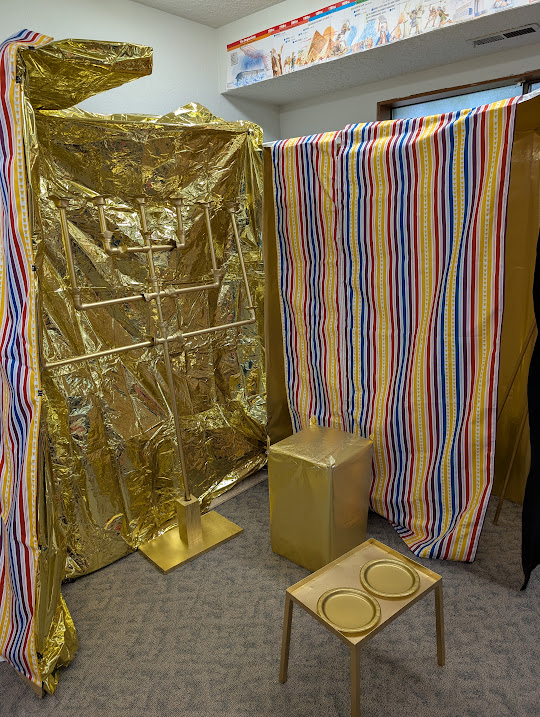
Altar of Incense
The altar of incense is made from a cardboard box covered in gold paper. The horns are gold paper triangles folded and taped onto the box. What is missing is the golden bowl that I put on it. I have a metal bowl spray painted gold that I can put real incense in.
Table of Bread of Presence

This one was the easiest for me because we happened to have a perfect metal table that I just had to spray paint gold.
I found gold plates at the Dollar Tree and Walmart.
Lamp stand
This one was by far the most difficult to make. Maybe I should have just purchased one, but I had quarter inch PVC pipe and an idea. Though this was plan B. Plan A was to get quarter inch metal pipe and have it bent to make each of the six candle branches and attach them using quarter inch fittings to the main metal pipe which would have been cut like the one in Plan B. In both plans, the pipe is painted gold and almond blossoms attached by pushing them onto the pipe. Doesn’t this sound complicated?

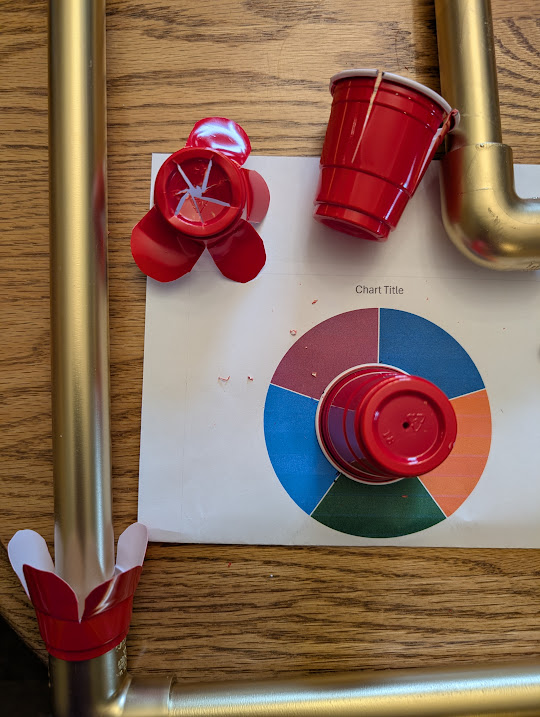

The center pipe is cut into the following pieces: 6″ top, 6″ to 2nd branch, 6″ to 3rd branch, 2’5″ for stand. The inner top left and right (first) branches are each cut 6 inches for outward piece and 6 inches for upper piece. They are attached with elbows and x piece in the center as the others will be also. The left and right branches of the 2nd branch are cut 12″ for each of the outward pieces and 12″ for the upper pieces. The left and right branches of the 3rd and final branch are cut 17″ for each the outward pieces and also 17″ for the upper pieces.
I cut the almond blossoms out of small plastic dixie cups . The 5 piece pie graph helped me know where to cut down to make the five petals of the almond blossom. Then I rounded each petal top. Finally, before spray painting them, I covered the inside and outside with air-dry modeling clay to help it look more like a flower. These slid onto the pipes before attaching the pipes to the connectors. The top blossoms were just big enough for battery operated tealights.
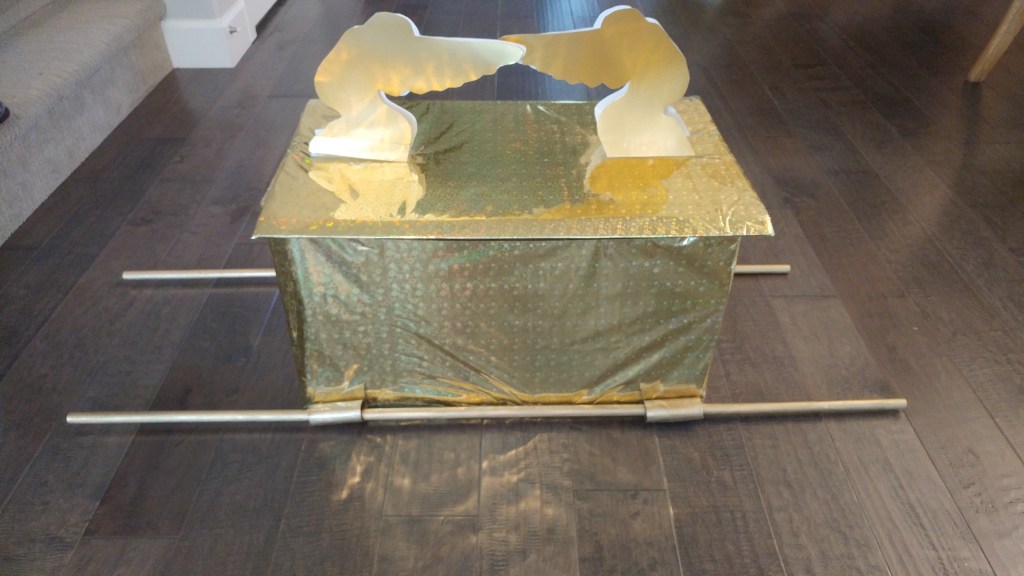
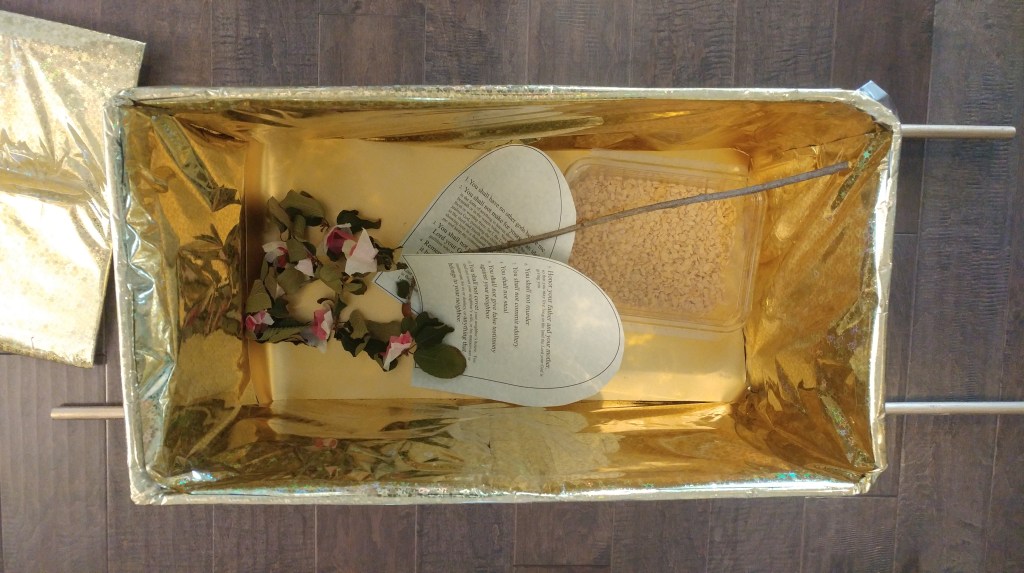
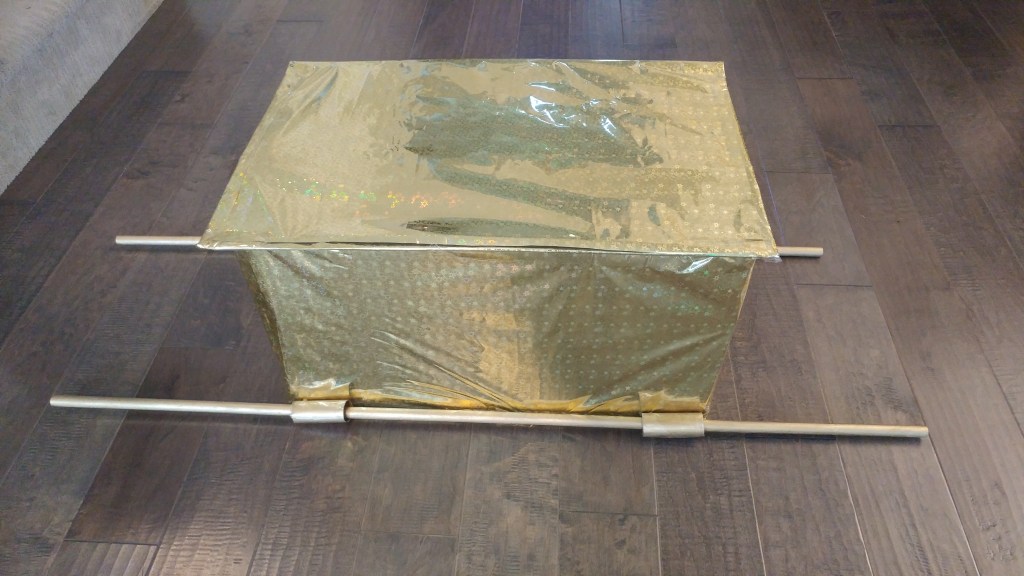
Ark of the Covenant

I made the Ark of the covenant from a card board box. I took of the the top flaps and covered it in gold wrapping paper. Christmas is a perfect time to find gold wrapping paper. Then I cut another piece of cardboard to fit over the top that was just a little bit bigger than the top so the box support it. I covered it with gold paper also. Then I enlarged images of the angels and cut out 4 from gold poster board with 2 facing the opposite way. They are attached with packaging tape. The nice thing is that I just flip this top upside down and it fits over the box with the angels on the inside to keep them nice. At the base of the box, I taped on toilet paper rolls painted gold to put golden dowels in so that we could carry it.




 Activity Array